Many buyers struggle to choose the right stand-up forklift because every warehouse demands different aisle widths, runtime, and operating styles.
The best stand-up forklifts combine tight turning radius, clear visibility, AC drive performance, and lithium battery compatibility. For most modern warehouses, stand-up reach trucks and stand-up counterbalance models deliver the highest efficiency in narrow aisles and fast-paced operations. I still remember when a customer switched from sit-down models to stand-up reach trucks—their picking speed improved instantly.
What Makes a Stand-Up Forklift “the Best” in Modern Warehouses?
The best stand-up forklifts provide tight turning radius, excellent visibility, ergonomic operator compartments, and long lithium-powered runtime for continuous operation.
When I help overseas buyers evaluate stand-up forklifts, I always start with maneuverability and operator experience. In narrow aisles—especially under 2.8 meters—turning efficiency determines productivity.
Battery technology is now a major deciding factor. Lithium batteries allow opportunity charging, reduce maintenance, eliminate watering, and remove ventilation concerns—adding 30–60 minutes of usable runtime per shift.
Operator visibility is crucial. Standing posture, slim mast profiles, and open windows provide a stronger view of the load and aisle.
AC drive systems are another requirement. Brushless AC motors handle long shifts with stable torque and low heat, outperforming older DC systems.

Maneuverability, Turning Radius & Narrow-Aisle Performance
A tight turning radius is the core advantage of stand-up forklifts.
Most customers I visit globally operate aisles between 2.6–3.0 meters, and stand-up forklifts avoid multi-point turns, saving several seconds per movement.
Key considerations:
- Stability during fast turns
- Smooth proportional control
- Precise load positioning
- Consistent steering feedback
For fast-paced order picking, the ability to pivot efficiently is essential.
Operator Visibility, Comfort & Safety Controls
Standing operation provides quicker entry/exit and better forward visibility.
Look for:
- Cushioned floor mats
- Side body support
- Intuitive joysticks
- Automatic cornering speed reduction
These reduce fatigue during long shifts.
Battery Compatibility (Lithium vs Lead-Acid) & Runtime
Lithium batteries offer:
- Zero watering
- No gas emission
- Fast charging during breaks
- Stable voltage for full-load lifting
Voltruk’s CATL / EVE / Gotion lithium packs include BMS protections for safe 3-shift operation.
Types of Stand-Up Forklifts and Their Ideal Applications
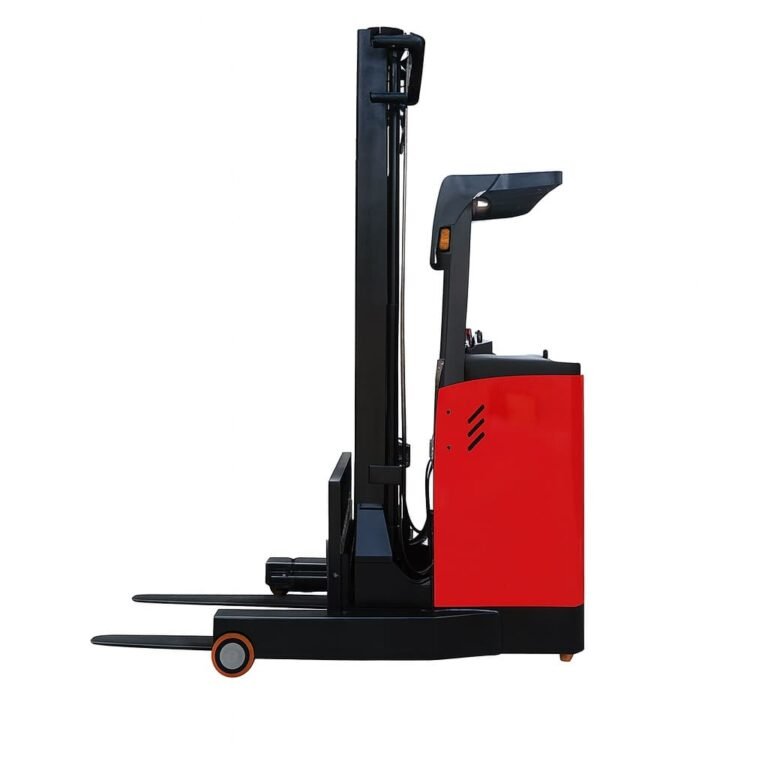
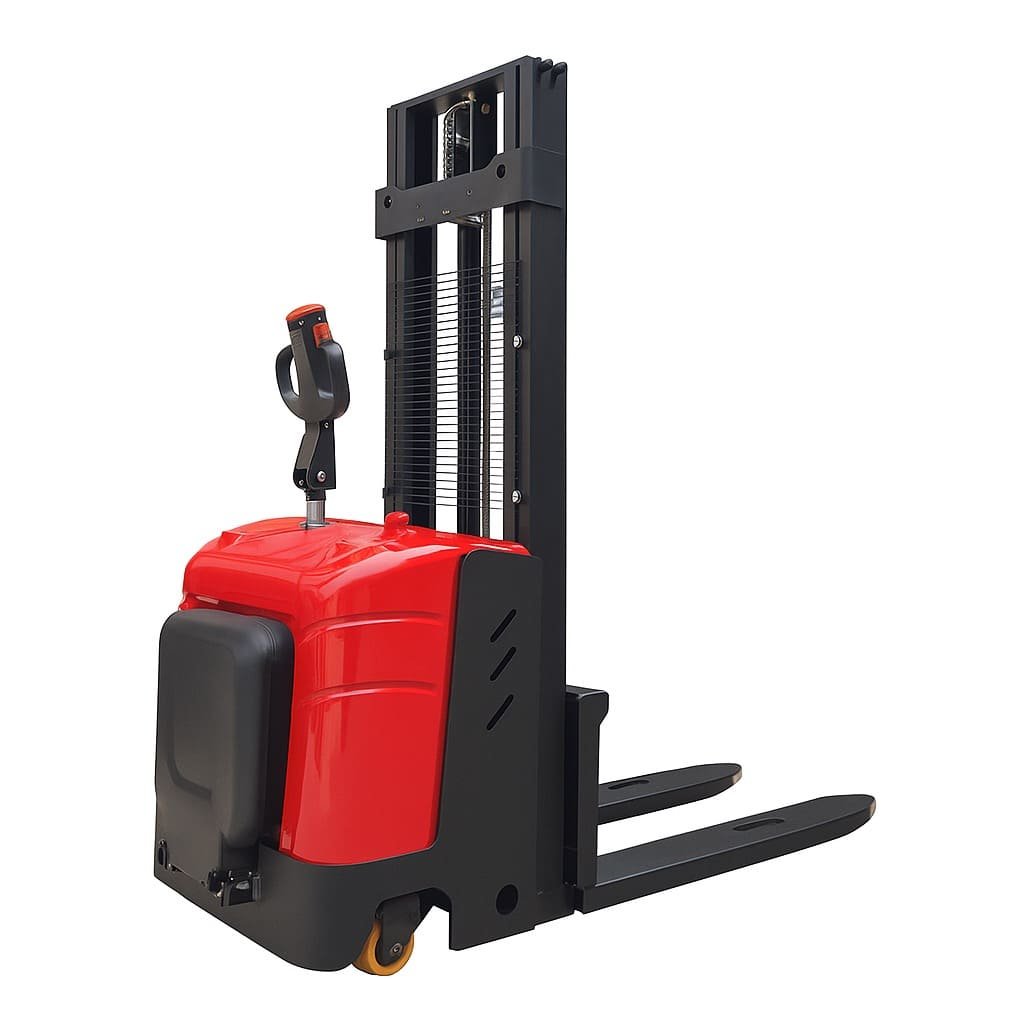
The best stand-up forklifts fall into three categories: stand-up counterbalance, stand-on reach trucks, and stand-on dock forklifts—each designed for different aisle widths, lift heights, and load requirements.
Many buyers confuse reach trucks with stand-up counterbalance forklifts, but their purposes differ significantly.
Stand-Up Counterbalance Forklifts
Ideal for:
- Mixed indoor/outdoor work
- Trailer loading
- Medium lift heights (3–5 meters)
- Standard pallet handling
They handle uneven ground better than reach trucks because the load stays outside the wheelbase.
Stand-On Reach Trucks
Best for:
- Narrow aisles (2.5–2.8 meters)
- High-bay storage (7–12 meters)
- E-commerce and cold-chain operations
The pantograph/reach mechanism dramatically reduces aisle requirements.
Stand-On Dock & Delivery Forklifts
Built for:
- Rapid forward/backward cycles
- Tight dock turning
- Frequent operator entry/exit
- Lower lift heights (2.5–4 meters)
Ideal for busy inbound/outbound warehouse operations.
Cold-Chain, Retail, and E-commerce Use Cases
Stand-up forklifts are widely used in:
- Grocery distribution
- Refrigerated warehouses
- High-frequency picking zones
- Retail backrooms
Lithium performs better than lead-acid in cold environments.
Comparing the Top Stand-Up Forklift Brands & Models
Top brands include Toyota, Crown, and Raymond, while Voltruk offers a factory-direct lithium alternative with strong value for distributors and rental fleets.
Toyota, Crown, Raymond — Strengths and Limitations
Toyota
- Outstanding reliability
- Large dealership network
- Higher price
Crown
- Excellent ergonomics
- Stable reach systems
- Costly maintenance in some regions
Raymond
- Excellent narrow-aisle performance
- Widely used in US DCs
- More expensive parts
These brands offer strong performance but often come with long lead times and higher ownership costs.

Voltruk Electric Stand-Up Options (Factory-Direct Advantage)
Voltruk’s stand-up lineup includes:
- Stand-on reach trucks
- Stand-up counterbalance units
Powered by:
- AC drive motors
- Lithium batteries (CATL/EVE/Gotion)
- Reinforced mast rails
- OEM customization
- Factory-direct pricing
Many distributors scale quickly with our models due to high value-per-dollar.
Battery Packs, Safety Sensors, and OEM Features
Voltruk supports:
- Blue/red pedestrian lights
- Speed limit settings
- PIN-code access
- Custom brand colors
- OEM decals and packaging
Typical delivery: 20–25 days.
Key Specifications Buyers Should Check Before Choosing a Stand-Up Forklift
The most important specs are load capacity, lift height, turning radius, battery type, and drive motor performance.
Load Capacity, Mast Height & Stability Requirements
Capacity guide:
- 1.5T → tight warehouses
- 2.0T → general distribution centers
- 2.5T → heavy loads
Mast options:
- 2-stage → lower cost
- 3-stage → better visibility & height
Stability relies on:
- Wide outriggers (for reach trucks)
- Low center of gravity
- Dual load wheels
AC Drive Motors, Controllers & Performance Indicators
AC drive advantages:
- Low heat
- High torque
- No brush replacement
Check for:
- ZAPI / Curtis controller
- Smooth acceleration curve
- Good regenerative braking
These determine driving quality under full load.
Turning Radius, Speed Profiles & Acceleration Behavior
Key measurements:
- Outside turning radius
- Right-angle stacking clearance
- Travel speed
- Auto cornering slowdown
A good stand-up forklift stays responsive even after 6–8 hours of operation.
Cost Breakdown: Upfront Price vs Lifetime ROI
Stand-up forklifts cost more upfront than pallet trucks but deliver excellent ROI through faster cycle times, aisle-space savings, and lower energy use—especially with lithium batteries.
Battery Life, Charging Time & Energy Consumption
Lithium:
- Charges in 1–2 hours
- High energy efficiency
- No watering
Lead-acid:
- Requires ventilation rooms
- Needs cooling periods
- Lower efficiency
Maintenance, Parts Access & Downtime Costs
Cost factors include:
- Brake wear
- Steering sensor faults
- Mast chain maintenance
- Tire replacement
Voltruk offers a simple after-sales policy: Photo → Credit/Replacement.
3-Year ROI Model for Buyers
Typical 3-year savings with lithium stand-up forklifts:
- 20–30% energy savings
- 40–60% fewer maintenance hours
- 30–120 hours less downtime yearly
- Faster operator productivity
Common Problems With Stand-Up Forklifts (and How to Avoid Them)
Common issues include overheating, electrical faults, steering misalignment, and mast wear. Most failures are avoidable with proper cleaning, inspections, and charging habits.
Overheating, Electrical Faults & Operator Misuse
Frequent causes:
- Excessive direction switching
- Hot environments
- Moisture exposure
- Wrong chargers
Solutions:
- Keep ports clean
- Use correct chargers
- Monitor temperature
- Train operators
Mast Wear, Steering Issues & Brake Degradation
Wear points:
- Rollers
- Chains
- Brake pads
- Steering sensors
Recommended inspection:
- Weekly lubrication
- Monthly steering calibration
- Battery cable checks
Cleaning, Inspection & Battery-Safety Checklist
Cleaning:
- Avoid pressure washing
- Keep sensors dry
- Clean floor mats
Battery safety:
- Do not deep discharge
- Avoid long-term 100% storage
- Use OEM charging systems
How to Pick the Right Stand-Up Forklift for Your Facility
Choose based on aisle width, lift height, pallet weight, runtime, and operator skill. A lithium stand-up reach truck suits most modern warehouses.
Aisle Width, Inventory Type & Working Hours
Match the forklift to your environment:
- Narrow aisles → Stand-on reach truck
- Docks + aisles → Stand-up counterbalance
- Cold-chain → Lithium reach truck
- High picking volume → Stand-up dock forklift
Safety Requirements & Training Expectations
Look for:
- PIN-code access
- Auto-reverse sensors
- Speed-limit profiles
- Fork height limiters
Operators switching from sit-down models adapt quickly.
Supplier Questions & Pre-Delivery Inspection Checklist
Ask your supplier:
- Is lithium available?
- What AC motor brand is used?
- LA warehouse stock?
- OEM lead time? (Voltruk: 20–25 days)
Check:
- Mast smoothness
- Controller calibration
- Tire condition
- Battery SOC accuracy
Conclusion
Stand-up forklifts are the best option for warehouses needing fast maneuvering, narrow-aisle operation, and high picking efficiency. For distributors and rental fleets, adding stand-up models improves competitiveness in e-commerce and logistics markets.
Voltruk offers lithium-powered stand-up forklifts with OEM branding, fast delivery, and complete export support.
Ready to Build Your Stand-Up Forklift Fleet?
✅ Get wholesale quote
✅ Request OEM samples
✅ Download temperature chart PDF
✅ Visit LA warehouse
✅ Email Frank: info@voltruk.com
FAQ (10)
Q1: What is a stand-up forklift best used for?
Narrow aisles, fast-paced operations, and frequent operator entry/exit—especially in e-commerce and distribution centers.
Q2: Are stand-up forklifts safer than sit-down forklifts?
Often yes, due to better visibility and quicker exit, but training is essential.
Q3: Difference between stand-up reach truck and stand-up counterbalance?
Reach trucks → narrow aisles & high lifts.
Counterbalance → heavier loads & limited outdoor use.
Q4: Do stand-up forklifts work in cold storage?
Yes—lithium models are ideal.
Q5: What is the typical price?
Prices vary, but factory-direct lithium models from Voltruk offer strong value.
Q6: Can they be used outdoors?
Stand-up counterbalance → short outdoor use
Reach trucks → indoor only
Q7: Is lithium better than lead-acid?
Yes—faster charging, longer life, no maintenance.
Q8: Aisle width needed for stand-up reach truck?
Typically 2.5–2.8 meters.
Q9: How to maintain a stand-up forklift?
Inspect brakes, steering sensors, mast rollers, and battery connectors regularly.
Q10: Does Voltruk offer OEM customization?
Yes—custom colors, branding, decals, and packaging with 20–25 day lead time.