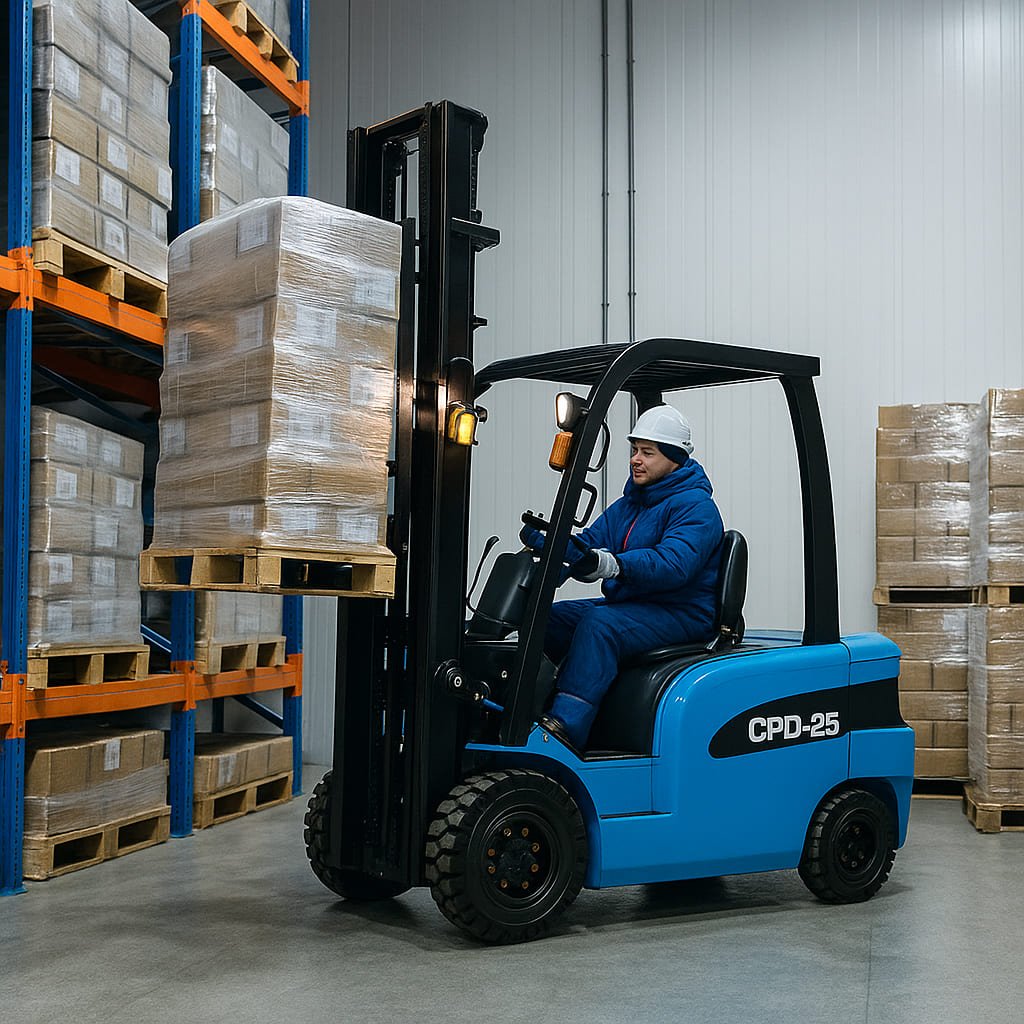
Most forklift accidents I see in overseas warehouses have one root cause: the load was carried too high. Height looks harmless—until stability disappears.
A forklift load should be carried low—typically 10–15 cm (4–6 inches) off the ground—so the truck stays stable while traveling. Keeping the forks low maintains a safe center of gravity, improves visibility, and prevents tip-over risk in turns, ramps, and uneven floors.
Years ago in a Middle East customer’s warehouse, I watched a newly trained driver turn sharply with the forks raised. The pallet didn’t fall—but the forklift nearly did. That moment shaped how I explain load height to buyers today.
What Is the Safe Height to Carry a Forklift Load?
The safe travel height for a forklift load is 10–15 cm (4–6 inches) from the ground. This keeps the center of gravity low, improves stability, and prevents tipping during movement, turning, or braking.
Forklifts are engineered around the stability triangle. Keeping the load just above ground keeps the center of gravity inside that triangle. Raise the forks too high and the triangle narrows—making the truck more likely to tip.
To reinforce this, OSHA’s official forklift guidelines emphasize traveling with the load as low as possible:
https://www.osha.gov/sites/default/files/publications/OSHAbooklet-forklifts.pdf
Every warehouse I visit—U.S., Europe, Asia—follows the same rule:
carry as low as possible, with just enough clearance to avoid obstacles.
Why 10–15 cm?
- Clears bumps, floor cracks, dock plates
- Keeps load stable
- Improves forward visibility
- Reduces mast vibration
- Keeps center of gravity low
Voltruk forklifts are tested under QC simulation to maintain smooth travel at low fork height using reinforced axles and sealed controllers.
Why 10–15 cm Is the Global Standard
International safety bodies—including OSHA, ISO, and European CE guidelines—all recommend low fork travel height.
EU warehouse rules:
https://osha.europa.eu/en/themes/warehousing
This is not arbitrary. At 10–15 cm:
- The load clears common ground obstacles
- Stability remains high
- Sudden stops or turns are less dangerous
- Visibility is optimal
In regions like Africa or Latin America, where floor conditions vary, low forks reduce the impact of uneven surfaces or unexpected dips.
How Forklift Speed Affects Safe Load Height
Speed multiplies instability.
A forklift moving fast with raised forks behaves like holding a bowl of water while running—any sudden direction change causes a shift.
Even with Voltruk’s smooth AC acceleration, I tell customers:
Never combine speed + height.
For safe driving guidance, OSHA recommends slowing down when loads block vision:
https://www.osha.gov/etools/powered-industrial-trucks
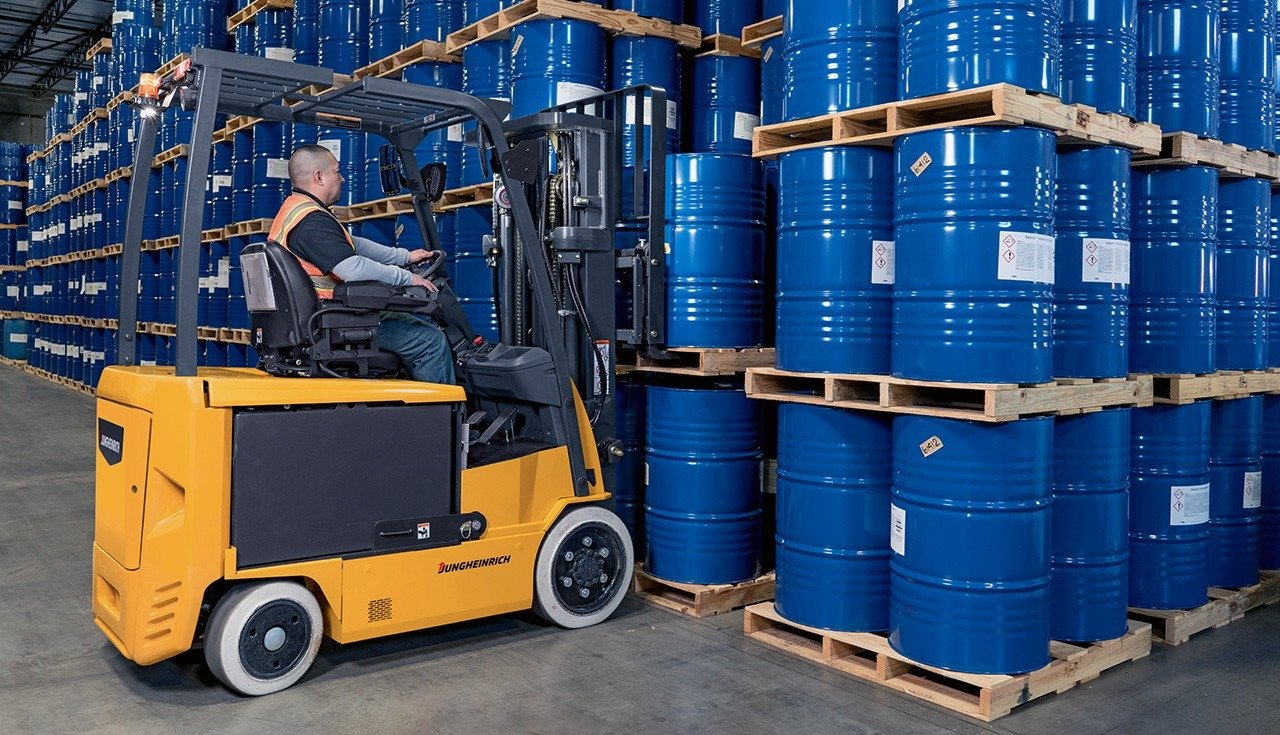
Why Should the Load Stay Low While Traveling?
The load stays low to maintain stability, reduce tip-over risk, protect the mast, and ensure clear visibility. High forks raise the center of gravity and make the forklift unstable during turns, braking, ramps, and uneven ground.
Keeping the forks low prevents:
- Lateral tip-over
- Forward tip-over
- Mast strain
- Visibility obstruction
- Sudden shifts on uneven floors
An EU rental company I support showed me mast bearing wear caused entirely by drivers traveling with raised forks. No accident—just long-term mechanical stress.
Visibility and Driver Fatigue
Low forks = clear view ahead.
High forks = blocked vision → fatigue → risk.
In Chile, a customer reduced operator fatigue by 30% after enforcing low-fork travel. Drivers no longer leaned sideways or strained their necks.
For visibility guidelines, the CDC provides operator ergonomics recommendations:
https://www.cdc.gov/niosh/topics/ergonomics/
Mechanical Stress and Mast Longevity
Raising a load places stress on:
- Lift chains
- Tilt cylinders
- Mast rollers
- Bearings
Traveling with raised forks accelerates mast wear—even without hitting anything.
At Voltruk, we perform:
- Mast fatigue test
- Cycle lifting test
- Hydraulic seal inspection
- Chain tension verification
But even the best mast lasts longer when traveled low.
Factors That Affect Safe Load Height
Load height depends on floor conditions, load weight, center of gravity, visibility, and forklift type. These factors determine how low or high the forks can safely travel without compromising stability.
10–15 cm is the baseline—but conditions vary.
Floor Conditions (150–180 words)
Floor quality varies worldwide. Old warehouses have wavy floors. Cold-chain floors get icy. Loading docks have metal plates that cause vibration.
Two impacts:
- Clearance needs — poor floors require slightly higher fork travel (15–20 cm).
- Stability needs — rough floors require slower movement and tighter control.
A forklift hitting an uneven joint at high fork height creates rocking motion that shifts the center of gravity dangerously.
I advise:
- Maintain consistent travel height
- Slow down at floor transitions
- Train drivers for slopes & bumps
For warehouse flooring standards, refer to:
https://www.concrete.org
Voltruk forklifts use reinforced axles and imported hydraulic seals to absorb vibration—but correct load height is still the main safeguard.
Load Weight & Center of Gravity (150–180 words)
Tall, uneven, or off-center loads are more unstable. The heavier or taller the load, the lower the forks should travel.
One Turkish customer handling tall fabric rolls kept loads at <10 cm and tilted back slightly. Accident risk dropped immediately.
Key rules:
- Heavy loads = lower forks
- Tall loads = lower speed
- Off-center loads = re-palletize before moving
Voltruk’s lithium battery counterweight helps stability, but operators must still travel low.
NIOSH explains how load distribution affects industrial vehicle stability:
https://www.cdc.gov/niosh/docs/2001-109/pdfs/2001-109.pdf
Operator Visibility (150–180 words)
High forks block the route ahead. Operators lean sideways or look around the load, creating blind spots.
After a U.K. warehouse enforced low-fork travel:
- Visibility improved
- Fatigue dropped
- Collision incidents decreased 60%
Voltruk wide-view masts help, but no design can fix a chest-high load during travel.
Situations That Require Different Load Heights
Snippet (≤50 words)
Special conditions—ramps, tight aisles, uneven outdoor surfaces, or dock transitions—may require slight adjustments. Even so, forks must stay as low as possible while safely clearing obstacles.
Ramps (150–180 words)
Ramps alter center-of-gravity behavior:
- Uphill → load shifts backward
- Downhill → load shifts forward
Best practices:
- Keep forks low
- Tilt mast back
- Travel straight (no turning)
- Load must always face uphill
OSHA ramp guidance clearly warns against elevated loads on slopes:
https://www.osha.gov/forklift/evaluation
Tight Aisles (150–180 words)
In narrow aisles:
- High forks hit racks
- Swings amplify sway
- Collisions destabilize the truck
I recommend:
- ≤10 cm travel height
- Walking speed
- Lift only when fully aligned with racking
This is especially important for reach trucks designed for vertical lifting—not traveling with raised loads.
Outdoor Yards (150–180 words)
Outdoor work involves:
- Gravel
- Potholes
- Slopes
- Wind
Rule:
Raise only enough to clear obstacles—no higher.
Voltruk forklifts are engineered for outdoor torque and hydraulic strength, but low travel height remains the core safety rule.
For outdoor forklift safety:
https://www.hse.gov.uk/workplacetransport/forklifts.htm
How Voltruk Forklifts Improve Load Stability
**Voltruk forklifts use AC motors, reinforced masts, lithium battery counterweight, and sealed controllers to maintain stability at low load heights—reducing vibration, swaying, and sudden center-of-gravity shifts.
AC Drive Stability (150–180 words)
Our AC motors:
- Provide smooth, steady acceleration
- Prevent jerky starts
- Handle slopes with uniform torque
This stability at low fork height is critical when carrying fragile or tall loads.
AC drive also means:
- No brushes
- Less heat
- Lower maintenance
Technical AC motor basics (U.S. Energy Dept.):
https://www.energy.gov/eere/vehicles/articles/electric-motors
Mast Engineering & Load Control (150–180 words)
Voltruk masts include:
- Reinforced channels
- Imported seals
- High-grade rollers
- Chain-tension calibration
- Tilt-cylinder inspection
We perform:
- Mast lift tests
- Load-cycle simulations
- Vibrations tests at low fork height
A strong mast ensures long-term stability—traveling low extends life further.
Battery as Counterweight (100–150 words)
Our lithium batteries (CATL, EVE, Gotion) serve as a dense, low-positioned mass—optimizing center of gravity.
Battery technology reference:
https://www.energy.gov/eere/vehicles/articles/lithium-ion-battery-basics
This design gives Voltruk forklifts:
- Stronger balance
- Better slope handling
- More predictable control
Conclusion
Carrying a forklift load at 10–15 cm is one of the simplest ways to reduce accidents, extend equipment life, and improve driver comfort. After visiting hundreds of warehouses worldwide, I can say confidently: low load height is a universal best practice.
Voltruk forklifts are engineered for low-height stability with:
- AC motors
- Reinforced masts
- Lithium counterweight
- 15–25 day delivery
- 1-unit MOQ
- OEM branding
- LA warehouse stock
If you're choosing a forklift model or updating SOPs, I’m here to help.
👉 Get wholesale quote
👉 Request OEM samples
👉 Download temperature chart PDF
👉 Visit LA warehouse
👉 Email Frank: info@voltruk.com
FAQ (10)
Q1: What is the safest height to carry a forklift load?
The safest travel height is 10–15 cm (4–6 inches), enough to clear the ground but low enough to maintain stability.
Q2: Why is traveling with raised forks dangerous?
High forks raise the center of gravity, reduce visibility, and increase tip-over risk.
Q3: Can I carry a load higher on smooth flooring?
No. Elevated loads create instability regardless of smoothness.
Q4: How should I travel on a ramp?
Forks low, mast tilted back. Load must face uphill.
OSHA reference: https://www.osha.gov/forklift/evaluation
Q5: Does forklift type change safe travel height?
All forklifts—diesel, electric, reach trucks—must travel with low forks.
Q6: How does load weight affect safe height?
Heavier, taller, or off-center loads require even lower forks.
Q7: What if the load blocks visibility?
Travel in reverse—never raise the forks to see under a load.
Q8: Should I tilt the load while traveling?
Yes, slightly tilt back to prevent forward sliding.
Q9: Does Voltruk provide training materials?
Yes—manuals, safety charts, and remote training.
Q10: Can I visit Voltruk’s LA warehouse to test units?
Yes. Contact info@voltruk.com to schedule a visit.