In warehouses, space pressure grows every year. Many buyers ask me how they can store more pallets without expanding their building. That’s where reach forklifts come in.
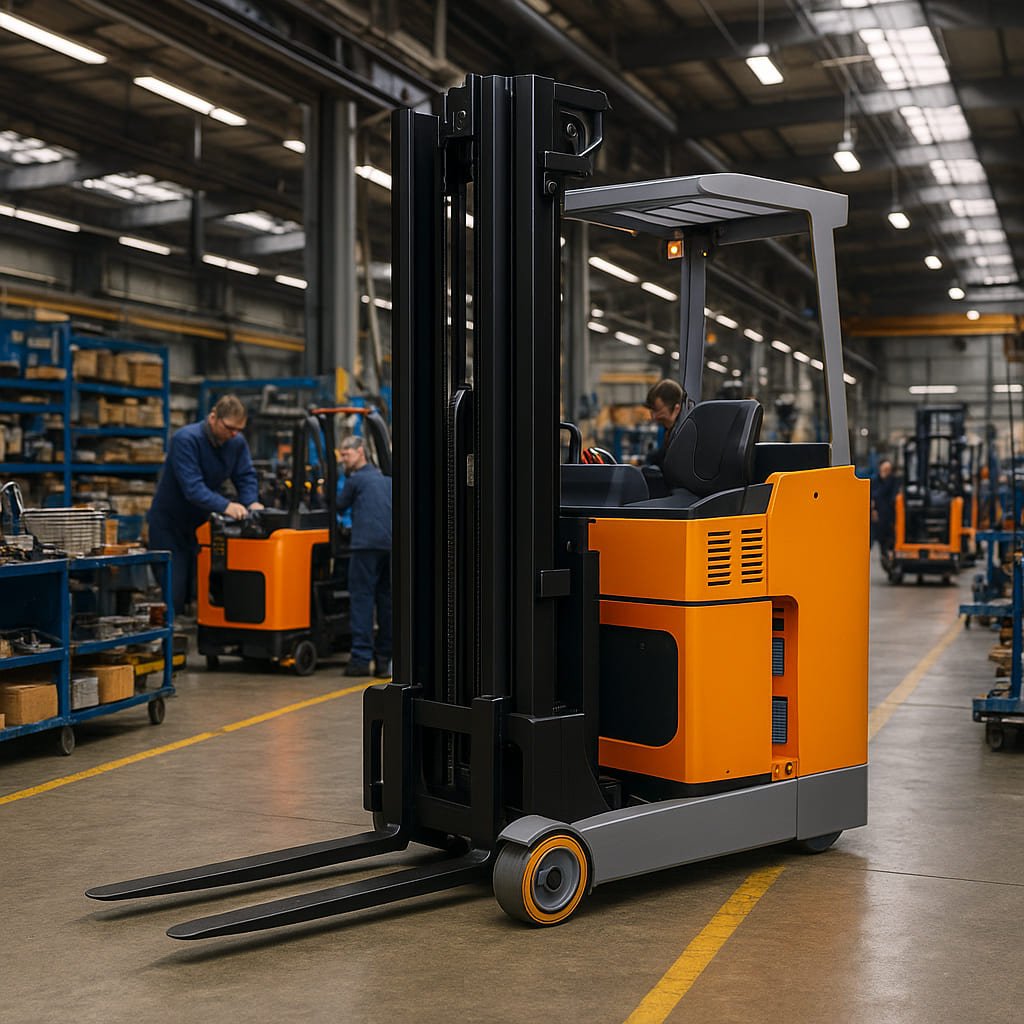
A reach forklift is a narrow-aisle warehouse truck with an extending mast that allows the operator to “reach” into racks and lift pallets up to 8–12 meters while keeping the machine compact and stable.
I still remember helping a distributor in Malaysia upgrade from counterbalance trucks to reach trucks; they doubled their pallet positions without expanding the warehouse.
This guide gives you a clear, practical explanation—no fluff.
How does a reach forklift work?
A reach forklift works by using an extendable mast that moves forward to pick up pallets inside narrow aisles, then retracts to bring the load close to the chassis for stability during travel.
The mast extends like an arm, grabs the pallet, then pulls it back toward the body. This reduces the load center and keeps stability high.
During factory testing, I always check:
- Mast extension smoothness
- Load stability at height
- Battery output during full lift
Modern reach forklifts use AC drive motors and CANbus electronics, giving smoother acceleration and better high-lift control.
The mechanics behind the extending mast
The reach system uses hydraulic cylinders + a scissor-like carriage.
When the operator moves the joystick:
- Hydraulic pressure pushes the mast forward
- Retracting brings the load closer to the center of gravity
At 10–12 meters high, even small tilts matter—this system ensures stability.
How reach trucks stabilize loads at height
Stability comes from:
- Outriggers
- Low center of gravity
- Electronic lift control
Some buyers worry outriggers reduce maneuverability, but in narrow aisles, they are essential.
Power system differences: AC drive vs older DC systems
AC systems provide:
- Smoother creeping speeds
- Strong torque for tall lifts
- Lower maintenance
- Better compatibility with lithium BMS
Most new warehouses now use lithium + AC drive configurations, especially cold-chain.
What are the types of reach forklifts?
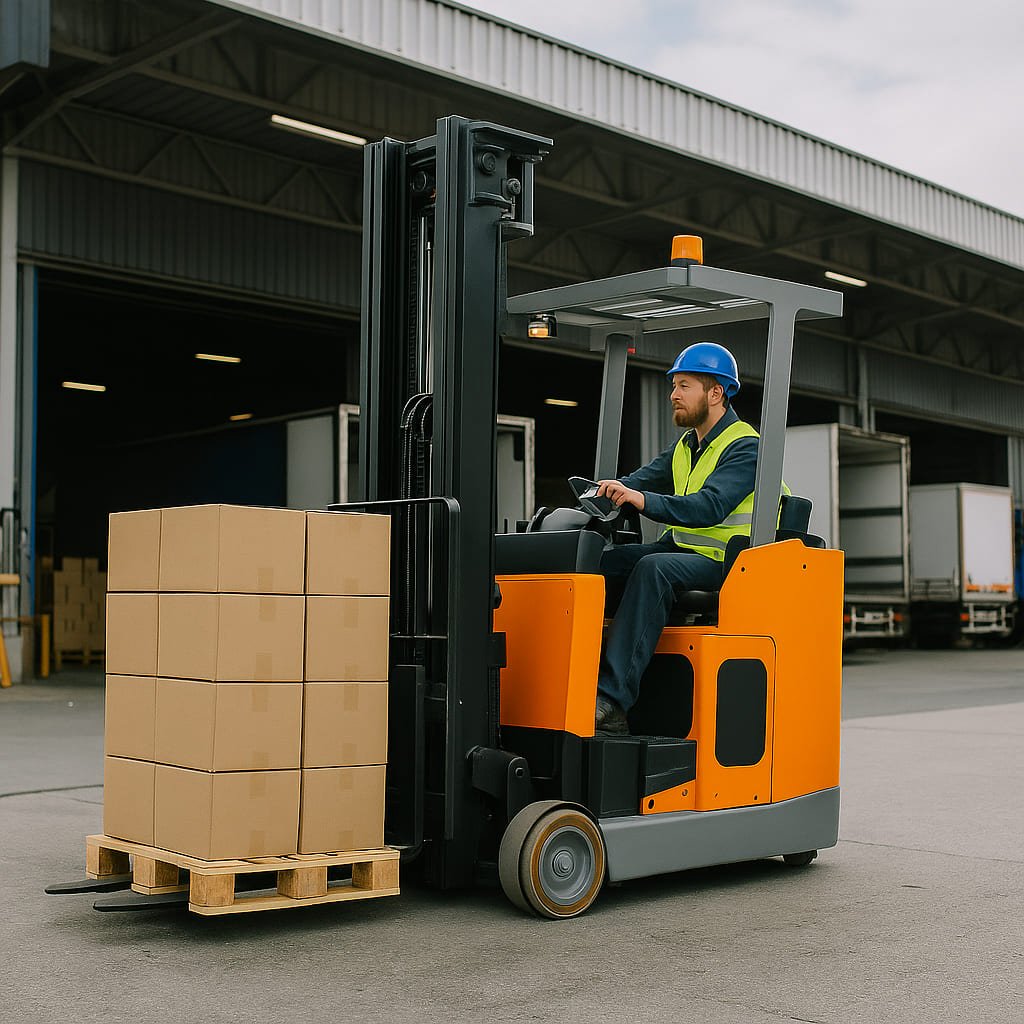
Reach forklifts come in several types:
- Stand-on reach trucks
- Moving-mast reach trucks
- Double-deep reach trucks
- Multi-directional reach trucks
When I help buyers choose a model, I always start with aisle width + lift height.
Stand-on reach forklifts
Popular in Asia and Europe.
Great for:
- Medium heights
- Frequent pallet handling
- Fast on/off cycles
Moving-mast reach trucks
The classic Linde/Volvo-type trucks.
Mast extends forward while the chassis stays compact.
Great for:
- 8–12 m racking
- Narrow aisles
Our CQDZ series belongs to this category.
Double-deep reach trucks
Designed for accessing two pallets deep.
Useful in:
- Beverage warehouses
- High-density storage
- Space-saving facilities (20–30% more capacity)
When to choose each type
- Narrow aisles → moving-mast
- High-density storage → double-deep
- Fast operations → stand-on
- Long materials (steel, wood) → multi-directional
What is a reach forklift used for?
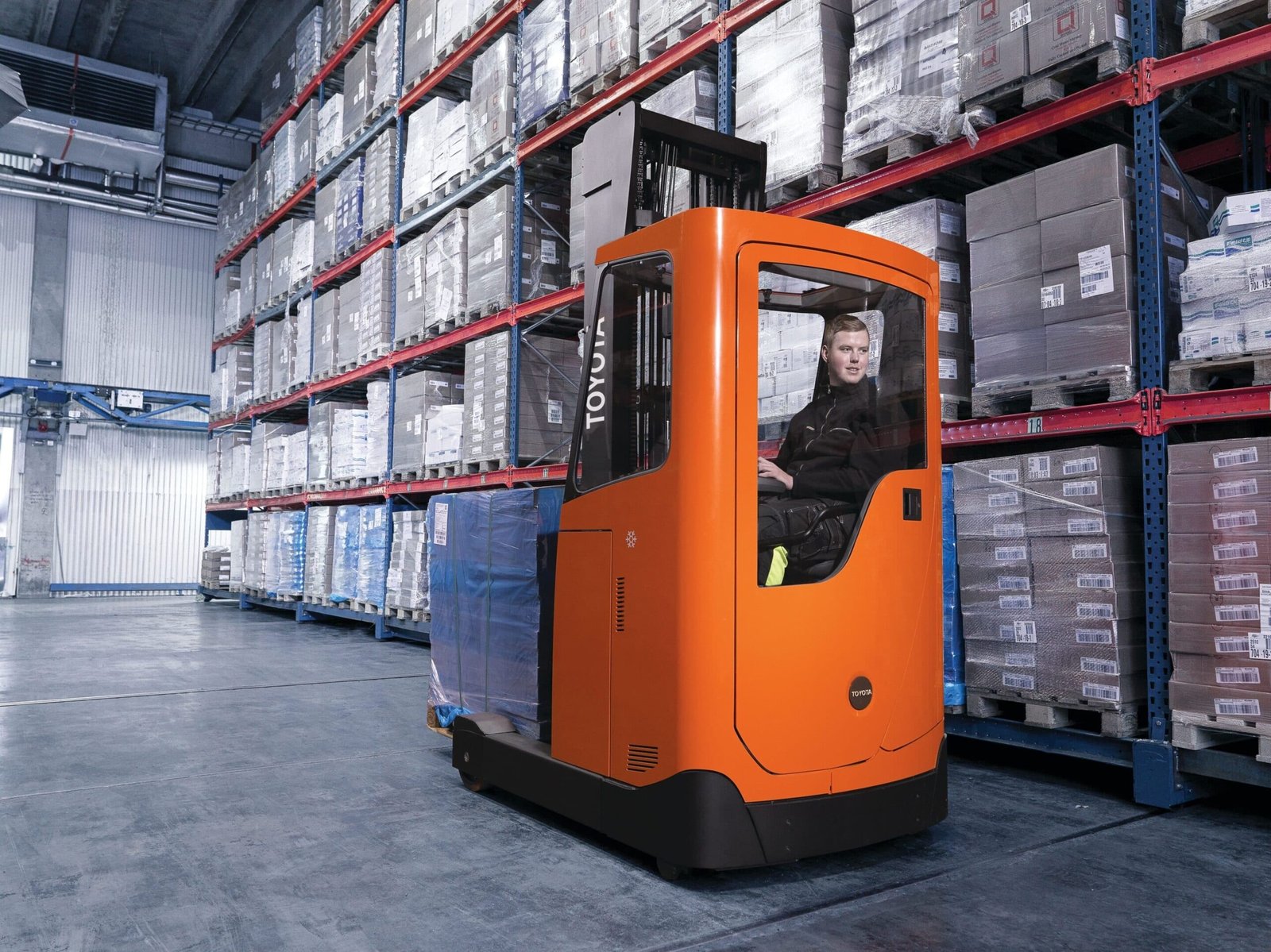
A reach forklift is used for:
- High-bay pallet storage (8–12m)
- Narrow-aisle warehouses (2.4–3.0m)
- Cold-storage logistics
- Food, pharmaceutical, retail distribution
In many projects, reach forklifts replace counterbalance trucks to increase storage without construction.
High-bay pallet storage
Modern racking reaches 10–12 meters.
Reach trucks provide:
- Fine lift control
- Precise pallet placement
- Stable high-lift performance
Narrow-aisle operations (2.4–3.0m)
Counterbalance forklifts need 3.5–4.0m aisles.
Reach trucks work efficiently in aisles as narrow as 2.7–3.0m.
Cold-storage and food logistics
Lithium reach trucks with heated packs perform at -20°C.
We’ve deployed many units in cold-chain warehouses.
Reach forklift vs standard forklift: What’s the difference?
A reach forklift is designed for narrow aisles and high racks, while counterbalance forklifts are for general indoor–outdoor tasks.
Turning radius and aisle width
- Counterbalance forklift: 3.5–4m aisles
- Reach forklift: 2.7–3.0m aisles
Lifting height and stability
Reach trucks specialize in:
- Tall racks
- Precision lift
- Enhanced stability systems
Battery efficiency and working hours
Lithium reach trucks typically run 6–8 hours per charge.
AC drive = less heat + more runtime.
Cost & maintenance comparison
Counterbalance forklifts are cheaper upfront.
Reach trucks:
- Increase storage density
- Lower long-term costs
- Reduce maintenance (AC motors = no brushes)
How to choose the right reach forklift for your warehouse?
Choose a reach forklift by evaluating:
- Aisle width
- Lift height
- Racking structure
- Load weight
- Battery type
- Options (sideshift, cold-storage kit, camera)
I guide buyers through this simple checklist.
Step 1 — Check your aisle width
Measure the narrowest point, not the average.
Even 5–10 cm difference matters.
Step 2 — Confirm lift height and racking levels
Choose a mast 150–300 mm above your top racking position.
Step 3 — Select battery type
Lithium batteries (CATL/EVE/Gotion):
- Charge in 2–3 hours
- 2500+ cycles
- Maintenance-free
Cold-storage modifications
Cold-storage models need:
- Heated lithium packs
- Low-temp hydraulic oil
- Anti-condensation wiring
OEM customization options
We offer:
- Custom colors
- OEM logo
- Special forks
- Laser-cut nameplates
Many distributors use these to build private-label products.
Safety requirements for reach forklift operation
Safe operation requires:
- Load awareness
- High-lift stability control
- Proper visibility
- Operator training
Most high-lift accidents happen due to poor pallet entry or unstable loads.
Common risks at height
- Load shifting
- Damaged pallets
- Sudden braking
- Over-tilting
Pre-operation checklist
- Check forks
- Check mast lubrication
- Check battery SOC
- Test horn/lights
- Inspect floor
Training requirements
Operators should learn:
- Controlled mast retraction
- Smooth turning
- High-lift pallet entry
Some countries require certification.
Preventing tipping
- Never tilt forward at height
- Always retract mast before traveling
How much does a reach forklift cost?
Typical price: USD 4,000–12,000
Depends on:
- Capacity
- Mast height
- Battery type
- Brand
- Cold-storage upgrades
Price ranges (Lithium)
- 1.0T: $4,200–$6,000
- 1.5T: $5,500–$8,000
- 2.0T: $7,000–$12,000
Total cost of ownership (5 years)
Lithium reach trucks:
- Reduce electricity costs
- Reduce maintenance
- Longer battery life
- Lower downtime
Maintenance checklist for reach forklifts
Maintenance focuses on:
- Battery care
- Hydraulics
- Mast lubrication
- Roller inspection
Our factory uses a 42-step inspection before shipment.
Daily inspection
- Battery level
- Fork condition
- Tires
- Mast rails
Weekly inspection
- Hydraulics
- Rollers
- Electrical connectors
Lithium battery care
- Avoid deep discharge
- Keep SOC 20–90%
- Use original charger
Signs of wear
- Uneven forks
- Noisy rollers
- Slow mast lowering
Should you buy or rent a reach forklift?
Buy → long-term daily use
Rent → short-term projects or seasonal peaks
Rental is good for testing, but ownership becomes cheaper after 8–12 months.
Hidden rental fees
- Delivery charges
- Damage waivers
- Battery replacement fees
Conclusion
Reach forklifts transform warehouse operations—from narrow aisles to tall logistics centers. If you need higher racks, better space utilization, or lithium-powered efficiency, a reach forklift is one of the smartest investments you can make.
If you’d like help choosing the right model or preparing OEM samples, I’m here to support you.
CTAs
- Get a wholesale quote
- Request OEM samples
- Email Frank: info@voltruk.com
- Download battery temperature chart PDF
- Schedule an LA warehouse visit
FAQ (10)
Q1: What aisle width do I need for a reach forklift?
Most reach trucks need 2.7–3.0 meters. Measure the narrowest point.
Q2: Are reach forklifts suitable for cold storage?
Yes—use a lithium battery with heating and low-temp hydraulic oil.
Q3: How high can a reach forklift lift?
Standard: 6–8m
High-mast: 10–12m
Q4: Why do reach forklifts use outriggers?
They improve stability during forward reach.
Q5: Can reach forklifts replace counterbalance forklifts?
Indoors—yes. Outdoors—counterbalance is better.
Q6: Are lithium batteries worth it for reach trucks?
Absolutely. Fast charging + long cycle life + low maintenance.
Q7: Do reach forklifts need special operator training?
Training improves mast control and pallet entry accuracy.
Q8: How long does a reach forklift last?
Typically 7–10 years with proper maintenance.
Q9: Are reach forklifts hard to maintain?
No—daily checks are simple, and lithium reduces normal maintenance.
Q10: When is a double-deep reach truck necessary?
Only if you use double-deep rack systems.